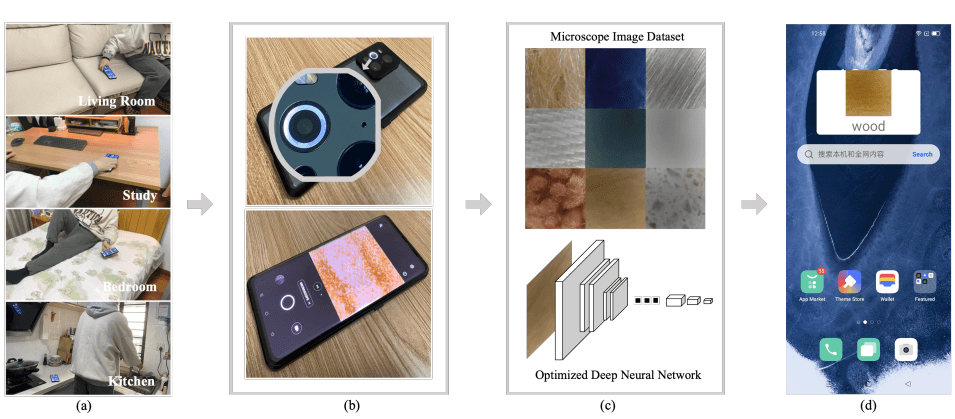
MicroCam (IMWUT ’23)
Turns a smartphone microscope camera into a low-cost sensor for recognizing contact surfaces and their fine-grained context.
Systems and prototypes connecting sensing to human interaction.
The research behind the workVisual detail, haptic feedback, and physiological interpretation.
Turns a smartphone microscope camera into a low-cost sensor for recognizing contact surfaces and their fine-grained context.
Accepted, in press
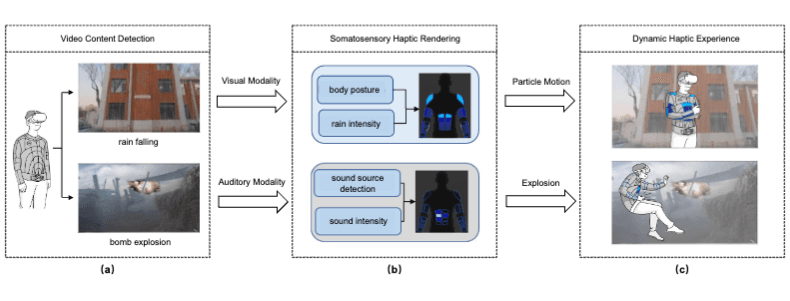
Transforms visual and auditory ambient cues into somatosensory electrical stimulation, extending haptic feedback in virtual reality.
UbiComp/ISWC Companion · Exploratory study
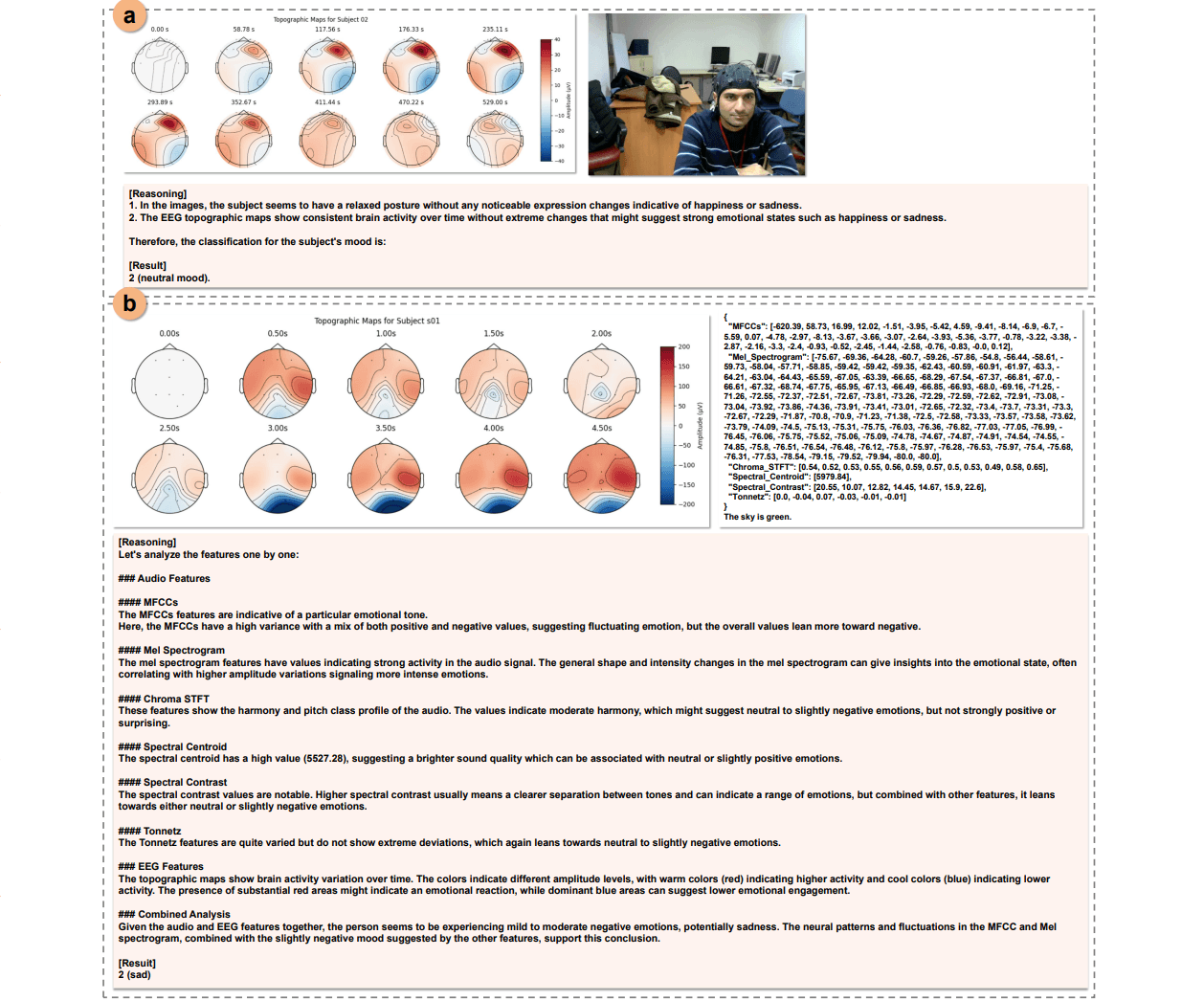
Explores EEG with facial or speech-derived context in language-model classification benchmarks, without claiming clinical validation.
The related IntervEEG-LLM framework explores how multimodal interpretations can inform supportive dialogue. Its example cases are not evidence of clinical effectiveness.
Multimodal reasoning, extended reality, accessibility, and tools.
Uses large-language-model agents to reason over multimodal surface-sensing signals for context-aware applications.
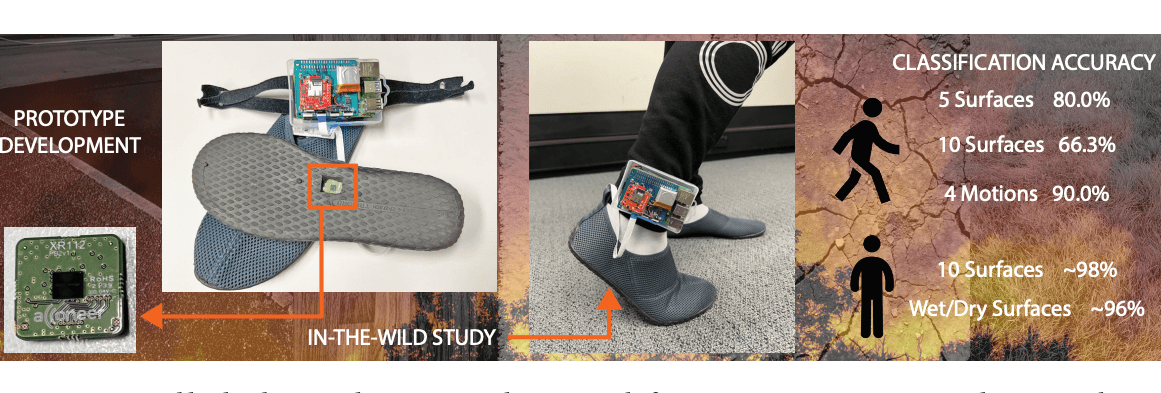
Embeds radar sensing in a smart shoe to recognize fine-grained ground-surface context during everyday movement.
Investigates how generative AI can facilitate image creation for spatial augmented-reality experiences.
Explores the design factors involved in employing generative AI for augmented-reality content and interaction.
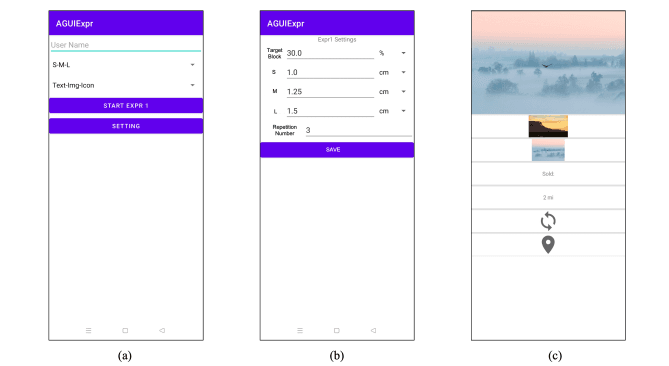
Adapts mobile interfaces to a user’s motion state so interaction remains legible and usable in dynamic settings.
Helps people without video-editing expertise create clear tutorial videos for smartphone interaction tasks.
Designs and recognizes foot gestures that help people with upper-body motor impairments use smartphones while in bed.
Combines sparse authentication with continuous user tracking to reduce repeated smartphone authentication in everyday use.
Extends tangible interaction from horizontal surfaces to walls through a responsive, wall-climbing robotic interface.
This project aims to facilitate content creation in projection scenarios by combining visual (depth dimension) and textual modalities.
How is radar sensing employed in HCI? How is it different from vision-based sensing methods?
Revise and resubmit · Not yet accepted
Combines spoken intent with RGB, infrared, and depth information for projection authoring and iterative user refinement.
Foundations in hardware, accessible media, modeling, and networks.
Explored how limited quantum keys can protect the most semantically important information in video content.
Created a pipeline for translating ordinary images into tactile graphics for accessible books.
A mathematical model balancing disease spread, medicine supply, delivery systems, and manufacturing capacity.
Designed FM modulation and demodulation circuits and evaluated them with NI ELVIS virtual instruments.
Built a web monitoring tool for inspecting and controlling a mobile robot’s operating state.
Designed and evaluated a low-noise RF amplifier using vector network analysis.