Ambient2Hap (ICME ’26)
Accepted, in press
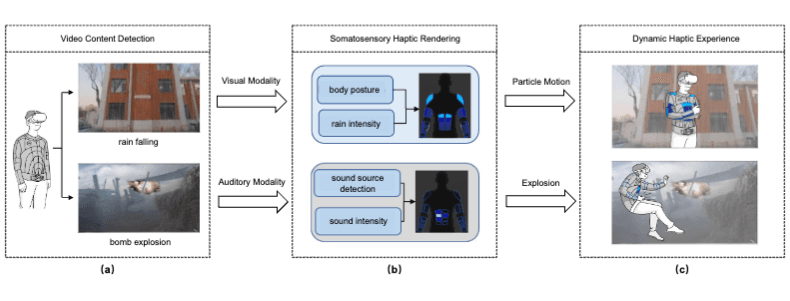
Transforms visual and auditory ambient cues into somatosensory electrical stimulation, extending haptic feedback in virtual reality.
Intelligent sensing
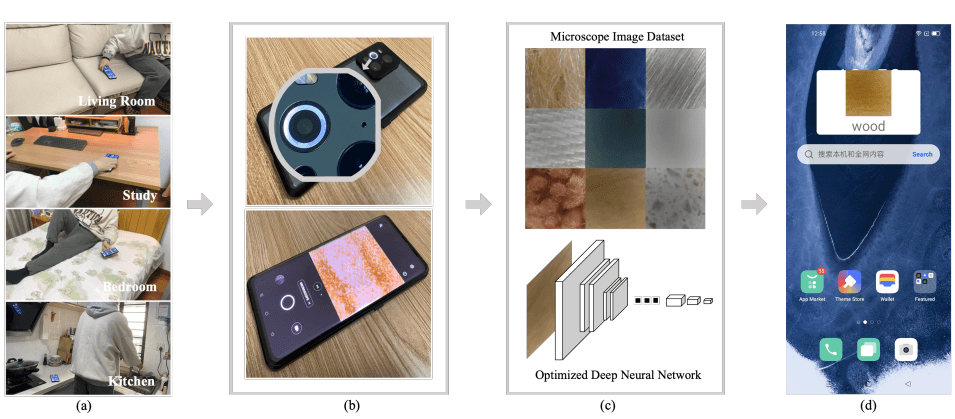
Turns a smartphone microscope camera into a low-cost sensor for recognizing contact surfaces and their fine-grained context.
MicroCam (IMWUT ’23)
Read the paperThe question
The approach
MicroCam uses a smartphone microscope camera as a low-cost surface sensor. Fine-grained visual observations provide evidence for recognizing contact surfaces and their context.
Evidence & scope
Maximum available image resolution: 1920 × 1080. Model input: 224 × 224 RGB. These describe one processing pipeline, not a resolution ablation experiment.
Leave-one-person-out evaluation with 12 participants: 95.56% object accuracy and 96.96% material accuracy across the collected classes.
Evaluation used one phone model and a computer-hosted classifier. Cross-device generalization and full on-device deployment remain separate questions.
This work brings context sensing to the physical detail at a contact point. It is one example of how a different sensing perspective can reveal information that a broad view of a scene may miss.
Explore this research directionAccepted, in press
Transforms visual and auditory ambient cues into somatosensory electrical stimulation, extending haptic feedback in virtual reality.
UbiComp/ISWC Companion · Exploratory study
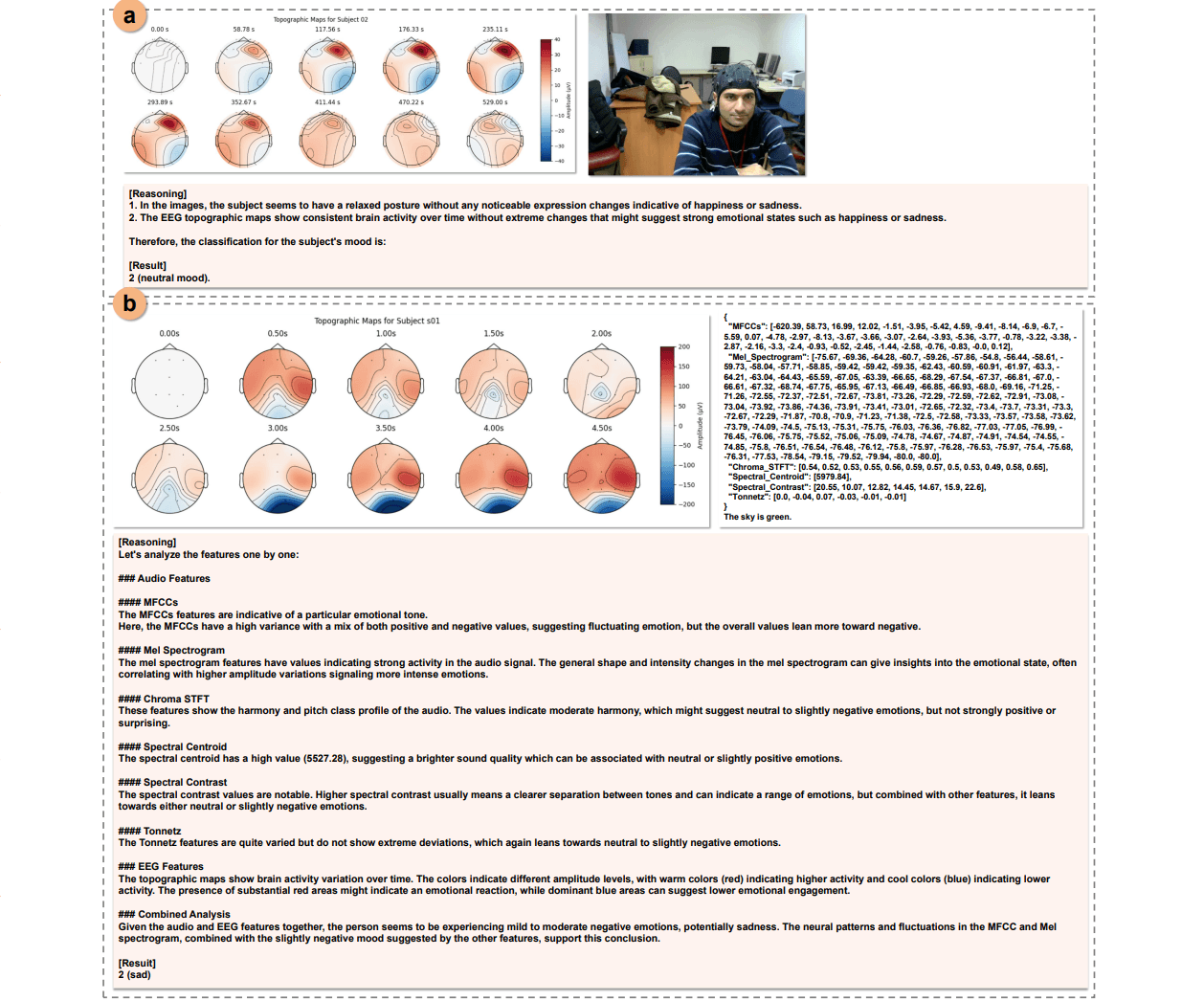
Explores EEG with facial or speech-derived context in language-model classification benchmarks, without claiming clinical validation.
The related IntervEEG-LLM framework explores how multimodal interpretations can inform supportive dialogue. Its example cases are not evidence of clinical effectiveness.
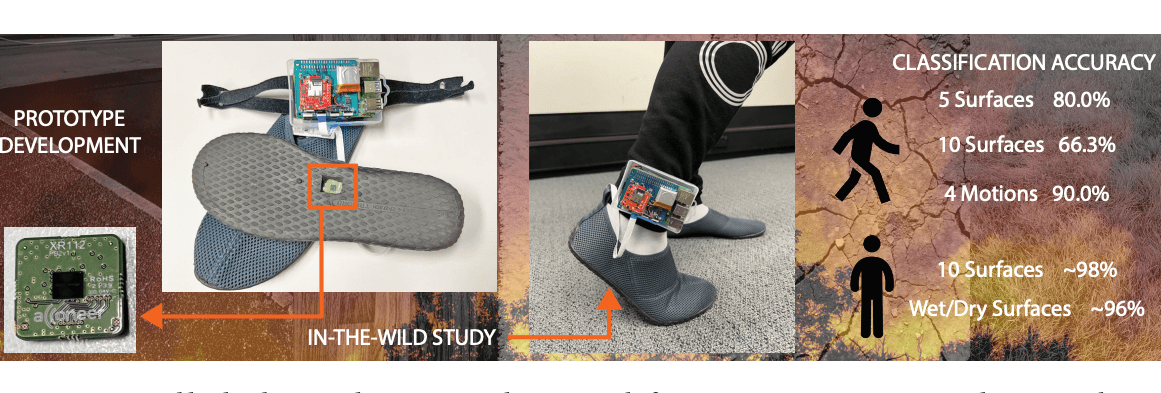
Embeds radar sensing in a smart shoe to recognize fine-grained ground-surface context during everyday movement.
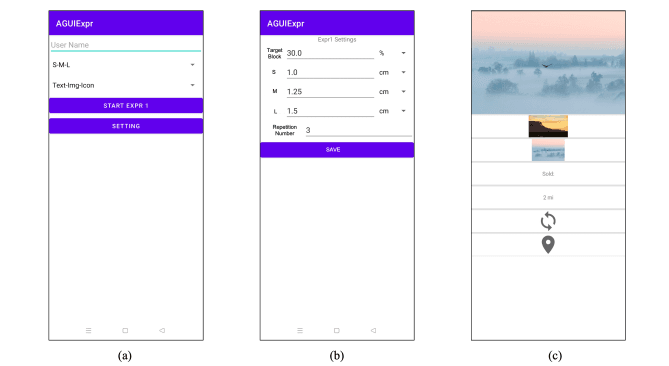
Adapts mobile interfaces to a user’s motion state so interaction remains legible and usable in dynamic settings.